Pages

Wednesday, January 21, 2009

List of Medical Eponyms

512ZA3FPQ5L._SS500_

Medical eponyms are always favorite choice of Questions be it for viva-voice or in Mcqs in competitive exams .So be thorough with them ,in the file provided you will have A-Z list of all medical eponyms .So read them well.

Download MEDICAL EPONYMS pdf file from 4Shared.


Check my other post for Eponymous signs in ENT.

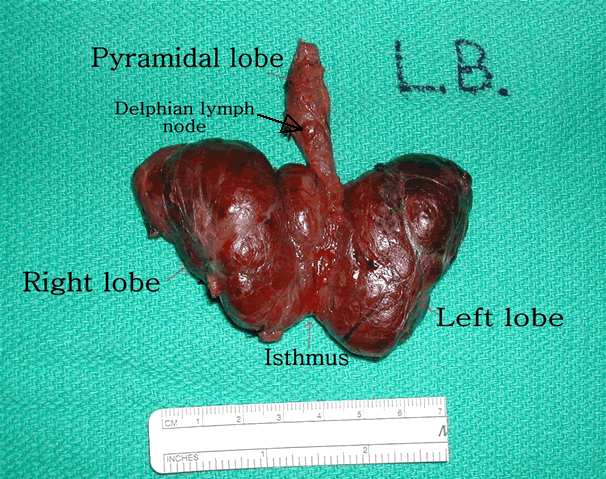
Delphian node

A midline prelaryngeal (cricotyhroid) lymph node.

delphian node


delphian


  • Receives lymphtic drainage from larynx & thyroid gland.
  • Can be enlarged in thyroid carcinoma or advanced larygeal cancer.
  • This node gets its name from Greek mythology. The Oracle of Delphi, called Pythria, was a Priestess who would answer questions posed to her, never concealing nor revealing the truth. Thus, an enlarged Delphian node may, or may not, indicate the presence of thyroid cancer.

What's this?


 Drugs_gastrograffin_01

The most commonly utilized contrast materials for GI examinations include barium sulfate and Gastrografin.


Barium represents the most widely used contrast agent.

Gastrograffin is the other alternative to Barium swallow and is used somewhat less commonly. This is a water-soluble contrast agent that can be diluted to varying strengths and ingested in a similar manner as barium sulfate.


Gastrograffin may be used both as a liquid drink, or as an enema.


Chemically it is Diatrizoate Meglumine .


Generally speaking, barium produces higher quality images than Gastrograffin.

It has the downside of having a chalky taste that is somewhat upsetting to some patient. It also has the disadvantage of producing a chemical peritonitis should a bowel perforation be present and the barium spills freely into the peritoneal cavity.

If GI transit is delayed, water will be progressively absorbed from the barium compound within the gastrointestinal tract, producing hard concretions which can form in the colon and cause constipation.

Gastrograffin, on the other hand, is water-soluble and well suited to performing GI examinations where suspicion for bowel perforation exists.

It has the main disadvantage of an extremely foul taste and is often poorly tolerated by patients when administered full strength. It also has been known to cause severe chemical pneumonitis if aspiration occurs.

For this reason, Gastrograffin should only be administered with extreme caution in patients known to aspirate or given through a conduit in patients presenting with a high risk for aspiration.

Gastrograffin is also hyperosmotic and tends to draw fluid into the bowel lumen as it passes through the GI tract. While this can be advantageous in helping eliminate stool in the constipated patient, this could be disaster in patients presenting with small bowel obstructions, as the osmotic pressure will produce a more progressive dilatation of the small bowel in the obstructed patient.

Sunday, January 11, 2009

Imaging of Facial Trauma(cont...)


Imaging Of Facial Trauma Part 3
In this slide presentation we are going to deal with the Pathology of Nasal ,NOE (naso-orbito-ethmoid), Frontal, Ethmoid fractures


Imaging of Facial Trauma(cont...)


Imaging Of Facial Trauma Part 2

In this slide presentation we will deal with the Anatomy basics required to know more about Facial Trauma


Imaging of Facial Trauma


Imaging Of Facial Trauma Part 1

Now we will start a slide presentation about the Facial Trauma


Imaging of Head Trauma (cont...)


Imaging of Head Trauma Part 2

Continuation of Head trauma slides. In this we discuss about the Pathology involved in Head Trauma


Imaging of Head Trauma


Imaging of Head Trauma: Part I


A slideshow of 'Imaging of Head Trauma: Part I' describes nature, mechanism, significance of head trauma, indications and choices of imaging in patients with head trauma, and normal anatomy of the brain with emphasis on CT.


Emergency Radiology


Emergency Radiology

We will deal with the basics of Radiology in this section.I am going to post some of the excellent slides present around online.
BTW ,dont forget to check a wonderful resource RadsPod:podcast on radiology.
Introduction to emergency radiology


Lines of Dolan and the elephants of Rogers

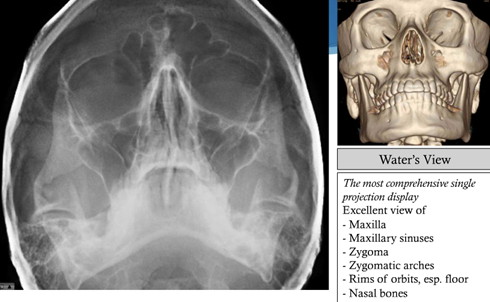
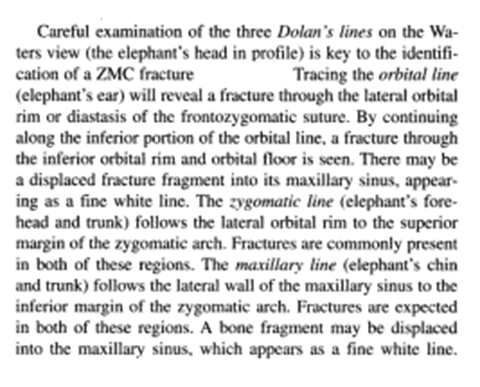
What are the lines of Dolan?

  • They are three anatomic contours best seen on the Waters view (occipitomental view )of the face, and they were first popularized by Dolan et al.
  • As you can see, the 3 lines of Dolan lead the eye along some facially important structures.
  • Lee Rogers pointed out that the 2nd and 3rd lines together form the profile of an elephant.


waters

water7

water2c

water2

    water3

ZMC fractures = Zygomaticomaxillary complex fractures or Tripod fractures

 water6

 water4

Sunday, January 4, 2009

What is this ?The Pemberton Sign

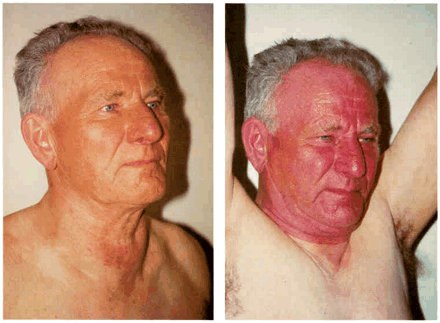
Head and neck with arms down (left) and arms elevated (right).

pemberton sign


This is Pemberton sign positive.

  • With years of continued growth, the thyroid may extend downward and
  • enlarge within the chest, resulting in a substernal goiter.

  • Symptoms and signs may arise from compression of the structures located within the bony confines of the thoracic inlet, including the trachea, esophagus, and vasculature .
  • The Pemberton maneuver is a physical examination method that elicits manifestations of latent increased pressure in the thoracic inlet by altering arm position to further narrow the aperture.
  • The maneuver involves "elevating both arms until they touch the sides of the head"; if the sign is present, "after a minute or so, congestion of the face, some cyanosis, and lastly distress become apparent".
  • The Pemberton sign is an important indicator of increased pressure in the thoracic inlet.
  • Pemberton sign occurs when the thoracic inlet becomes obstructed during positional changes, resulting in compression of the jugular veins.

It is a common manifestation of retrosternal goiter but may also occur with lung carcinoma, lymphoma, thymoma, or aortic aneurysms.

Petrosal nerves

Petrosal nerve (a nerve traveling through the petrous portion of the temporal bone) may refer to:

  1. Deep petrosal nerve
  2. Greater petrosal nerve (also known as the greater superficial petrosal nerve)
  3. Lesser petrosal nerve (also known as the lesser superficial petrosal nerve)
  4. External superficial petrosal nerve


Deep petrosal nerve:
The deep petrosal nerve (n. petrosus profundus; large deep petrosal nerve) is given off from the carotid plexus, and runs through the carotid canal lateral to the internal carotid artery.

It contains postganglionic sympathetic fibers with cell bodies located in superior cervical ganglion.

It then enters the cartilaginous substance which fills the foramen lacerum, and joins with the greater superficial petrosal nerve to form the nerve of the pterygoid canal(Vidian nerve).

Then pass through the pterygopalatine ganglion without synapsing, and then join the postganglionic parasympathetic fibers in supplying the lacrimal gland & nasal and oral mucosa.
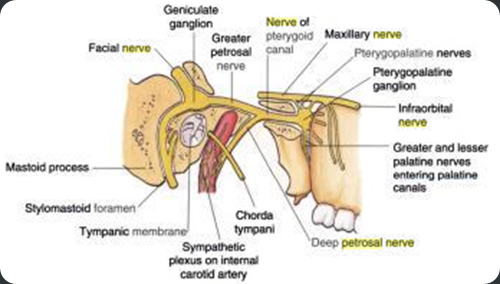
petrosal nerves


Greater petrosal nerve : The greater superficial petrosal nerve (n. petrosus superficialis major; large superficial petrosal nerve) is given off from the geniculate ganglion of the facial nerve; it passes through the hiatus of the facial canal, enters the cranial cavity, and runs forward beneath the dura mater in a groove on the anterior surface of the petrous portion of the temporal bone. It then enters the cartilaginous substance which fills the foramen lacerum, and joining with the deep petrosal nerve to form the nerve of the pterygoid canal.


greater petrous nerve


Vidian nerve : The nerve of the pterygoid canal (n. canalis pterygoidei [Vidii]; Vidian nerve), formed by the junction of the two preceding nerves in the cartilaginous substance which fills the foramen lacerum, passes forward, through the pterygoid canal, with the corresponding artery, and is joined by a small ascending sphenoidal branch from the otic ganglion. Finally, it enters the pterygopalatine fossa, and joins the posterior angle of the sphenopalatine ganglion.

vidian nerve

vidian nerve

The geniculate ganglion is formed by the juncture of the nervus intermedius and the facial nerve into a common trunk. Additional afferent fibers from the anterior two thirds of the tongue are added to the geniculate ganglion from the chorda tympani.

Three nerves branch from the geniculate ganglion:

  1. the greater superficial petrosal nerve,
  2. the lesser petrosal nerve, and
  3. the external petrosal nerve.

petrosal nerves

Lesser petrosal nerve :

  • The lesser petrosal nerve carries parasympathetic (secretory) fibers from both the tympanic plexus (from glossopharyngeal nerve (CN IX) via Jacobson's nerve) and the nervus intermedius, to the parotid gland.
  • It originates at the geniculate ganglion, passing forwards through its own canal back into the middle cranial fossa.
  • Here it is between the two layers of the dura mater, passing forwards to exit the skull via foramen ovale to eventually join the otic ganglion.

External superficial petrosal nerve:

  • The external petrosal nerve is an inconstant branch that carries sympathetic fibers to the middle meningeal artery.

Saturday, January 3, 2009

What is the diagnosis?

babesiosis

  • The peripheral-blood smear shows numerous intracellular organisms in red blood cells.
  • Multiple ring forms are seen, as well as rare tetrads (thin arrow).
  • These so-called Maltese cross formations are essentially pathognomonic of babesiosis.
  • The dark, round body in the right lower quadrant of the red blood cell with the tetrad is a Howell–Jolly body (thick arrow), an erythrocyte inclusion representing an incompletely extruded nucleus.
  • Howell–Jolly bodies are seen in patients with functional asplenia, and such patients are particularly susceptible to serious babesial and encapsulated bacterial infections.

Babesiosis is a worldwide tick-borne hemolytic disease that is caused by intraerythrocytic protozoan parasites of the genus Babesia.

The organisms are intraerythrocytic ring forms closely resembling Plasmodium, the organism causing malaria.

Three distinguishing features differentiate the two organisms.

    1. Babesial organisms usually form tetrads ("Maltese cross"),
    2. Do not have hemozoin pigments within the affected red blood cells and
    3. Have extracellular merozoites.

Babesia_LifeCycle

  • Atovaquone suspension (Mepron; 750 mg twice daily) plus azithromycin (Zithromax; 500 to 1,000 mg per day) is a very effective treatment.