Wonderful article from Indian journal of PEds—Neonatal Sepsis
Showing posts with label pediatrics. Show all posts
Showing posts with label pediatrics. Show all posts
Tuesday, September 29, 2009


Wednesday, September 9, 2009
AIIMS 2006(from AIPPG website)
LInk to original source-AIPPG.
Conjugated hyperbilirubinemia is seen in:
A. Gilbert’s syndrome
B. Griggler Najjar syndrome
C. Breast milk jaundice
D. Dubin Johnson syndrome
Ans. (D) Dubin Johnson syndrome
(Ref: Nelson’s Textbook of Pediatrics 17th Ed, Ch. 338, P-1321)
A 15-year-old female presented to the emergency department with history of recurrent epistaxis, hematuria and hematochezia. There was a history of profuse bleeding from the umbilicus stump at birth. Previous investigations revealed normal prothrombin time, activated partial thromboplastin time, thrombin time and fibrinogen levels. Her platelet counts as well as platelet function tests were normal but urea c1ot Jt. positive. Which one of the following clotting factor is most likely to be deficient?
A. Factor X
B. Factor XI
C. Factor XII
D. Factor XIII
Ans. (D) Factor XIII
(Ref: Nelson Pediatrics 17th Ed/P-1661)
Which one of the following is the characteristic feature of juvenile myoclonic epilepsy?
A. Myoclonic seizures frequently occur in morning
B. Complete remission is common
C. Response to anticonvulsants is poor
D. Associated absence seizures are present in majority of patients
Ans. (A) Myoclonic seizures frequently occur in the morning
(Ref: Harrison’s Principles of Internal Medicine 16th Ed. 2005—Part XV-Neurologic Disorders;Sec. 2-Diseases of the Central Nervous System;Ch. 348-Seizures and Epilepsy)
Plethoric lung fields are seen in all of the following conditions, except:
A. Atrial septal defect (ASD)
B. TAPVC (Total Anomalous Pulmonary venous connection)
C. Ebstein’s anomaly
D. Ventricular septal defect
Ans. (C) Ebstein’s anomaly
(Ref: Review of Radiology 3rd Ed/p-42-43)
Which of the following is an example of disorders of sex chromosomes?
A. Marfan’s syndrome
B. Testicular feminization syndrome
C. Klinefelter’ s syndrome
D. Down’s syndrome
Ans. (C) Klinefelter’ s syndrome
(Ref: Robbins and Cotrans’s Pathologic Basis of Disease 7th Ed/P-145)
Which of the following haemoglobin (Hb) estimation will be diagnostically helpful in a case of beta thalassemia trait?
A. Hb-F B. Hb1C
C. Hb-A2 D. Hb-H
Ans. (C) Hb-A2
(Ref: Nelsons Pediatrics 17th Ed/P-1633)
Which of the following circulating antibodies has the best sensitivity and specificity for the diagnosis of celiac disease?
A. Anti-endomysial antibody
B. Anti-tissue transglutaminase antibody
C. Anti-gliadin antibody
D. Anti-reticulin antibody
Ans. (A) Anti-endomysial antibody
(Ref: Nelsons Pediatrics 17th Ed/P-1265)
A couple has two children affected with tuberous sclerosis. On detailed clinical and laboratory evaluation (including molecular studies) both parents are normal. Which one of the following explains the two affected children in this family?
A. Non penetrance
B. Uniparental diasomy
C. Genomic imprinting
D. Germline mosaicism
Ans. (D) Germline Mosaicism
(Ref: Journal of Child Neurology/Vol. 19, No. 9, Sept. 2004)
Cardiomyopathy may be seen in all of the following except:
A. Duchenne muscular dystrophy
B. Friedreich’s ataxia
C. Type II glycogen storage disease
D. Alkaptonuria
Ans. (D) Alkaptonuria
Enzyme replacement therapy is available for which of the following disorders?
A. Gaucher disease
B. Niemann Pick disease
C. Mucolipidosis
D. Metachromatic leukodystrophy
Ans. (A) Gaucher’s disease (repeat)
In a child with acute liver failure, the most important prognostic factor for death is:
A. Increasing transaminases
B. Increasing bilirubin
C. Increasing prothrombin time
D. Gram negative sepsis
Ans. (C) Prothrombin time
(Ref: Diseases of the liver and the biliary system 11th Ed, Ch. 8-Acute Liver Failure, P-118)
Which of the following does not establish a diagnosis of congenital CMV infection in a neonate?
A. Urine culture of CMV
B. IgG CMV antibodies in blood
C. Intra-nuclear inclusion bodies in hepatocytes
D. CMV viral DNA in blood by polymerase chain reaction
Ans (B) IgG CMV antibodies in blood
(Ref: Cloherty’s Manual of Neonatal Care 5th Ed/P-257)
All of the following are true of β thalassemia major, except:
A. Splenomegaly
B. Target cells on peripheral smear
C. Microcytic hypochromic anemia
D. Increased osmotic fragility
Ans. (D) Increased osmotic fragility
(Ref: Manual of Pediatric Hematology and Oncology, 4th Ed/P-184)
Transient synovitis (toxic synovitis) of the hip is characterized by all of the following, except:
A. May follow upper respiratory infection
B. ESR and white blood cell counts are usually normal
C. Ultrasound of the joint reveals widening of the joint space
D. The hip is typically held in adduction and internal rotation
Ans. (D) The hip is typically held in adduction and internal rotation.
(Ref: Nelson’s Textbook of Pediatrics 17th Ed, Ch. 148, P-809)
A 3-year-old boy presents with fever, dysuria and gross hematuria. Physical examination shows a prominent suprapubic area which is dull to percussion. Urinalysis reveals red blood cells but no proteinuria. Which of the following is the most likely diagnosis?
A. Acute glomerulonephritis
B. Urinary tract infection
C. Posterior urethral valves
D. Teratoma
Ans. (B) Urinary tract infection
Which of the following statements is true of primary grade IV-V vesicoureteric reflux in young children?
A. Renal scarring usually begins in the midpolar regions
B. Postnatal scarring may occur even in the absence of urinary tract infections
C. Long-term outcome is comparable in patients treated with either antibiotic prophylaxis or surgery
D. Oral amoxicillin is the choice antibiotic for prophylaxis
Ans. (B) Postnatal scarring may occur even in the absence of urinary tract infections.
(Ref: Nelson’s Textbook of Pediatrics 17th Ed—Ch. 531-Vesicoureteric Reflux, P-1791-1793)
15-year-old boy presented with one day history of bleeding gums, subconjunctival bleed and purpuric rash. Investigations revealed the following results:
Hb-6.4 gm/dL; TLC-26,500/mm3 Platelet-35,000/mm3; prathrombin time–20 sec with a control of 13 sec; partial thromboplastin time-50 sec; and Fibrinogen 10 mg/dL. Peripheral smear was suggestive of acute myeloblastic leukernice. Which of the following is the most likely?
A. Myeloblastic leukemia without maturation
B. Myeloblastic leukemia with maturation
C. Promyelocytic leukemia
D. Myelomonscytic leukemia
Ans. (C) Promyelocytic leukemia
(Ref: Manual of Pediatric Hematology and Oncology, 4th Ed/P-306, 443)
The defective migration of neural crest cells results in:
A. Congenital megacolon
B. Albinism
C. Adrenogenital hypoplasia
D. Dentinogenesis imperfecta
Ans. (A) Congenital megacolon
(Ref: Schwartz’s Principles of Surgery 8th Ed. 2005— Part II- Specific Considerations; Ch. 38-Pediatric Surgery)
A premature infant is born with a patent ductus arteriosus. Its closure can be stimulated by administration of:
A. Prostaglandin analogue
B. Estrogen
C. Anti-estrogen compounds
D. Prostaglandin inhibitors
Ans. (D) Prostaglandin inhibitors
The loading dose of Aminophylline is:
A. 50-75 ug/kg
B. 0.5-1.0 mg/kg
C. 2.0-3.5 mg/kg
D. 5-6 mg/kg
Ans. (D) 5-6 mg/kg
Cushing’s Triad includes all except:
A. Hypertension
B. Bradycardia
C. Hypothermia
D. Irregular respiration
Ans. (C) Hypothermia
(Ref: Current Pediatric Diagnosis and Treatment 17th Ed. 2005—Ch. 11-Emergencies and Injuries)
All of the following drugs are used for managing status epilepticus except:
A. Phenytoin
B. Diazepam
C. Thiopentone sodium
D. Carbamazepine
Ans. (D) Carbamazepine
(Ref: Current Pediatric Diagnosis and Treatment 17th Ed. 2005—Ch. 23-Neurologic and Muscular Disorders; Table 23.9-Status epilepticus treatment)
Administration of glucose solution is prescribed for all of the following situations except:
A. Neonates
B. Child of a diabetic mother
C. History of unconsciousness
D. History of hypoglycemia
Ans. (C) History of unconsciousness
(Ref: Rudolph’s Pediatrics 21st Ed. 2003—24. The Endocrine System; 24.9-Hypoglycemia)
Which organ is the primary site of hematopoiesis in the fetus before midpregnancy?
A. Bone
B. Liver
C. Spleen
D. Lung
Ans. (B) Liver
(Ref: Nelson’s Textbook of Pediatrics 17th Ed/
P-1599)
All of the following are the complications in the new born of a diabetic mother except:
A. Hyper bilirubinemia
B. Hyperglycemia
C. Hypocalcemia
D. Hypomagnesemia
Ans. (B) Hyperglycemia
(Ref: Cloherty’s Manual of Neonatal Care 5th Ed./P-13-1
Thursday, May 21, 2009
Grey baby syndrome, Blue baby syndrome, Bronze baby syndrome, Carbon baby syndrome, Blueberry muffin baby syndrome – Decoded
Grey baby syndrome :
The grey baby syndrome is a rare condition almost exclusively seen in neonates and very young infants receiving high doses of CHLORAMPHENICOL.
Toxic blood levels of chloramphenicol occurs due to :
- inadeqaute conjugation of chloramphenicol with glucuronic acid because of inadequate activity of glucuronyl transferase in the newborn liver and
- decreased renal excretion of the unconjugated chloramphenicol leads
The infant is cyanosed, is acidotic, has cold peripheries and has the signs of all of marked hyponia, poor feeding, vomiting, loose stools and a distended abdomen.
Bronze baby syndrome:
When infants with cholestatic jaundice are exposed to phototherapy they may develop a greyish-brown discoloration of skin.
Probably due to accumulation of porphyrins & other metabolites (formed by action of phototherapy) in plasma of infants who develop cholestasis.Not all infants with cholestasis will develop it.
- Dark, grayish brown discoloration of skin
- May persist for months
- Associated with Conjugated Hyperbilirubinemia
Carbon baby syndrome:
Universal acquired melanosis is a rare form of hypermelanosis which was synonymously referred to as "Carbon baby".A form of progressive mucocutaneous pigmentation caused by singly dispersed melanosomes within keratinocytes.

Blue baby syndrome:
Here blue baby implies blue due to cyanosis.
It can be due to:
- cyanotic heart diseases or
- methemoglobinemia.
Blueberry muffin baby syndrome:
Blueberry muffin baby is a term used to describe neonates whose skin resembles a blueberry muffin (i.e., the skin shows diffuse, dark blue to violaceous purpuric macules and papules). The spots represent dermal hematopoiesis and are a sign of serious systemic disease, most often congenital infection. The congenital infection most commonly associated with this appearance is congenital rubella.check this dermatology link for a detailed explanation.


- MULTIPLE CUTANEOUS HEMANGIOMAS OF INFANCY (DIFFUSE HEMANGIOMATOSIS, BENIGN HEMANGIOMATOSIS)
- MULTIFOCAL LYMPHANGIOENDOTHELIOMATOSIS
- BLUE RUBBER BLEB NEVUS SYNDROME
- GLOMANGIOMA/GLOMUVENOUS MALFORMATION
| congenital viral infections | TORCH acronym for congenital infections: toxoplasmosis, other (syphilis, parvovirus, and other viral), rubella (the commonest cause), cytomegalovirus, and herpes simplex. |
| hematologic dyscrasias | Hemolytic disease of the newborn (ABO or Rh incompatibility) and hereditary spherocytosis. |
| Neoplastic disease | Neuroblastoma Leukemia cutis Langerhans' cell histiocytosis Congenital rhabdomyosarcoma with cutaneous metastases |
| cutaneous vascular anomalies. |
Wednesday, October 15, 2008
Pediatrics-high yield points
In Paediatrics , the relationship between (classical) onset of rash and day of fever can be memorized as below:
mnemonic''''
V"ery "S"ick "P"atient "M"ust "T"ake Double Tea.
Day 1 of fever: "v"aricella zoster
Day 2 of fever: "s"carlet fever
Day 3 of fever: small"p"ox
Day 4 of fever: "m"easles
Day 5 of fever: "t"yphus
day 6th- dengue fever
7th day.. Typhoid
Tuesday, October 7, 2008
Clinical images-Raccoon eyes
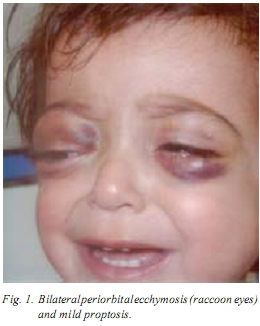
Raccoon eyes
A I5-month-old girl was admitted to hospital with the complaints of bruising around the eyes for 10 days. She had one month history of abdominal pain and accompanied by fever and vomiting for one week. Physical examination demonstrated pallor, periorbital ecchymoses (raccoon eyes) and bilaterally mild proptosis (Fig. 1). She also had a left sided abdominal mass, which was 5 × 8 cm in diameter. The laboratory investigation revealed hemoglobin level 6g/dL, white cell count 10,000/mm3 and platelet count 34,000/mm3 . Urinary vanillymandelic acid level was high. Bilateral bone marrow aspiration revealed infiltration with neuroblasts. Abdominal CT showed a left supra-renal mass (5 × 7 cm in diameter), which was diagnosed as a neuroblastoma on histo-pathologic examination.
- The metastatic involvement of the periorbital tissues. has been described and the resultant proptosis and orbital ecchymosis has been given the tag of ‘raccoon eyes’.
- Orbital metastases can be found in up to 20% of children with stage IV neuroblastoma.
- The characteristic "raccoon eyes" appearance associated with neuroblastoma and metastasis to the skull is probably related to obstruction of the palpebral vessels (branches of the ophthalmic and facial vessels) by tumor tissue in and around the orbits .
differential diagnosis:The correct diagnosis of this condition is sometimes delayed because of workup for child abuse or trauma. There are a multitude of differential diagnoses for the presentation of periorbital edema and ecchymosis,
e.g.,
- child abuse or trauma,
- infection of the soft tissues associated with a spreading dental infection and an allergic reaction.
- Other systemic causes to be considered include myxoedema,
- other neoplasias such as lymphoma or
- haematological coagulopathies such as haemophilia.
note:
- Neuroblastoma has been called the great mimicker because of its myriad clinical presentations related to the site of the primary tumor, metastatic disease, and its metabolic tumor by-products.
- Pepper syndrome occurs in infants with overwhelming metastatic neuroblastoma of the liver that results in respiratory compromise. Pepper syndrome was identified as a localized primary tumor and metastatic disease limited to the skin, liver, and bone marrow in infants. Pepper syndrome has since been associated with stage 4S neuroblastoma, a unique entity that occurs only in infants younger than 1 year. Pepper syndrome generally confers a better prognosis, as it is associated with spontaneous regression.
- "Blueberry muffin" babies are infants in whom neuroblastoma has metastasized to random subcutaneous sites. When provoked, the nodules become intensely red and subsequently blanch for several minutes thereafter. The response is probably secondary to the release of vasoconstrictive metabolic tumor by-products. These nodules can be diagnostic of neuroblastoma, but leukemic infiltrates that metastasize to the skin should be considered in the differential diagnoses when these children are evaluated.
- Widespread metastasis of neuroblastoma to the bone may result in Hutchinson syndrome, which results in bone pain with consequent limping and pathologic fractures. Neuroblastomas that arise in the paraspinal ganglia may invade through the neural foramina, compress the spinal cord, and subsequently cause paralysis
- The most common finding upon physical examination is a nontender, firm, irregular abdominal mass that crosses the midline. In contrast, children who present with Wilms tumor have a smooth mobile flank mass that typically does not cross the midline.
Bronchiolitis and related mcqs
Bronchiolitis is a disorder most commonly caused in infants(mostly 3 -6 months of age) by viral lower respiratory tract infection (LRTI). It is the most common lower respiratory infection in this age group. It is characterized by acute inflammation, edema and necrosis of epithelial cells lining small airways, increased mucus production, and bronchospasm.
Causes
RSV is the most common pathogen (85%), but other organisms occasionally produce a similar clinical picture.
- Adenovirus (11%) occasionally causes a similar syndrome with a more virulent course.
- Epidemics of bronchiolitis due to parainfluenza virus usually begin earlier in the year and tend to occur every other year.
- Other less common etiologic agents include the following:
-
- Mycoplasma pneumoniae
- Enterovirus
- Influenza virus
- Rhinovirus
- Chlamydia pneumoniae
Pathophysiology
- Necrosis of the respiratory epithelium is one of the earliest lesions in bronchiolitis and occurs within 24 hours of the acquisition of infection.
- Proliferation of goblet cells results in excessive mucus production, whereas epithelial regeneration with nonciliated cells impairs elimination of secretions.
- Lymphocytic infiltration may result in submucosal edema.
- The pathology results in obstruction of bronchioles from inflammation, edema, and debris, leading to hyperinflation, increased airway resistance, atelectasis, and ventilation-perfusion mismatching.
Infants are affected most often because of their small airways, high closing volumes, and insufficient collateral ventilation. Recovery begins with regeneration of bronchiolar epithelium after 3-4 days, but cilia do not appear for as long as 2 weeks. Macrophages remove mucus plugs.
clinical features:
Signs and symptoms are typically rhinitis, tachypnea, wheezing, cough, crackles, use of accessory muscles, and/or nasal flaring. Many viruses cause the same constellation of symptoms and signs.
Most patients with bronchiolitis have the following signs:
- Tachypnea, often at rates over 50-60 breaths per minute (most common physical sign)
- Tachycardia
- Fever, usually in the range of 38.5-39°C
- Mild conjunctivitis or pharyngitis
- Diffuse expiratory wheezing
- Nasal flaring
- Intercostal retractions
- Cyanosis
- Inspiratory crackles
- Otitis media
- Apnea, especially in infants younger than 6 weeks
- Palpable liver and spleen from hyperinflation of the lungs and consequent depression of the diaphragm
note:
- Respiratory rate in otherwise healthy children changes considerably,
- mean of approximately 60 breaths per minute upto 2 months of age
- approximately 50 breaths per minute from 2 months to 12 months of age and
- 40 breaths per minute from 12 months to 5 years of age.
- Counting respiratory rate over the course of 1 minute may be more accurate than measurements extrapolated to 1 minute but observed for shorter periods.
- The absence of tachypnea correlates with the lack of LRTIs or pneumonia (viral or bacterial) in infants.
- hyperinflation is present in bronchiolitis(due to obstruction pathway) but absent in pneumonia.
Physical examination findings of importance include respiratory rate, increased work of breathing as evidenced by accessory muscle use or retractions, and auscultatory findings such as wheezes or crackles.
Download bronchiolitis-clinical guidelines pdf file with total A to Z information on the topic before attempting the mcqs
mcqs
Acute bronchiolitis is associated with
- a) a higher incidence in infants than in school children
- b) the production of copious amounts of purulent sputum
- c) widespread fine crackles
- d) a polymorphonuclear leucocytosis
- e) respiratory syncitial virus infection
ans:
- true :a,c,e
- purulent sputum indicates bacterial infection
- Lymphocytic infiltration is present
The following statements are true of bronchiolitis
- a) up to 50% of patients continue to wheeze after recovery
- b) the typical pathogen is para influenza virus
- c) corticosteroid therapy is beneficial
- d) tachypnoea is invariable
- e) air-trapping is normally present
ans:
- true=a,d,e
- RSV is the most common pathogen
- air trapping due to airway obstruction leads to hyper-inflated lungs
The following are known to cause bronchiolitis in infants EXCEPT:
- Para influenza
- Chlamydia
- Mycoplasma
- Streptococcus pneumoniae
- Human metapneumovirus
ans:4
Which of the following is correct regarding bronchiolitis?
a) It is more common in the summer months.
b) Parainfluenza virus is the commonest cause.
c) The disease is most common in children aged 2-4 months.
d) Wheezing is a highly specific symptom for bronchiolitis.
ans:c) The disease is most common in children aged 2-4 months.
Bronchiolitis is more common in winter. Respiratory syncytial virus (RSV) is the most common cause. Although wheezing is often seen in bronchioloitis, it may also be seen in many other respiratory conditions.
Concerning bronchiolitis:
A. Epidemics often occur during winter.
B. A chest radiograph usually shows a poorly inflated chest.
C. Poor feeding is an indication for treatment with ribavirin.
D. The disease is more benign in infants born prematurely.
E. Respiratory syncytial virus is the most common causative virus.
ans:
- true=a,e
- false=b,c,d
A 12 months old baby has fever. Recently, two other family members had an upper respiratory tract infection. On examination of the baby you find that his body temperature is 37.5 degree celsius and chest auscultation reveals bilateral wheezing. What is the MOST LIKELY cause?
a.Acute bronchiolitis
b.Viral croup
c.Bronchial Asthma
d.Pneumonia
e.Foreign body
ans: a(age group & family history of upper respiratory infection along with wheeze suggests it )
In acute viral bronchiolitis of infancy which one of the following is TRUE
A.Crepitations are rarely heard
B.Bronchodilators are not indicated because they aggravate hypoxaemia
C.Adenovirus causes a more severe illness than respiratory syncytial virus
D.High dose intravenous corticosteroids will modify the course of the disease
E.Intravenous fluid at twice maintenance volumes is indicated
ans:C
Subscribe to:
Posts (Atom)